Chess History
Who Is Caissa? The Story Behind the Goddess of Chess
Chess has no ancient goddess, yet Caissa has inspired players and writers for centuries. Discover how a literary figure became the enduring muse of the game.
Caissa Is a Literary Figure, Not an Ancient Goddess
A modern mythology created around an ancient game
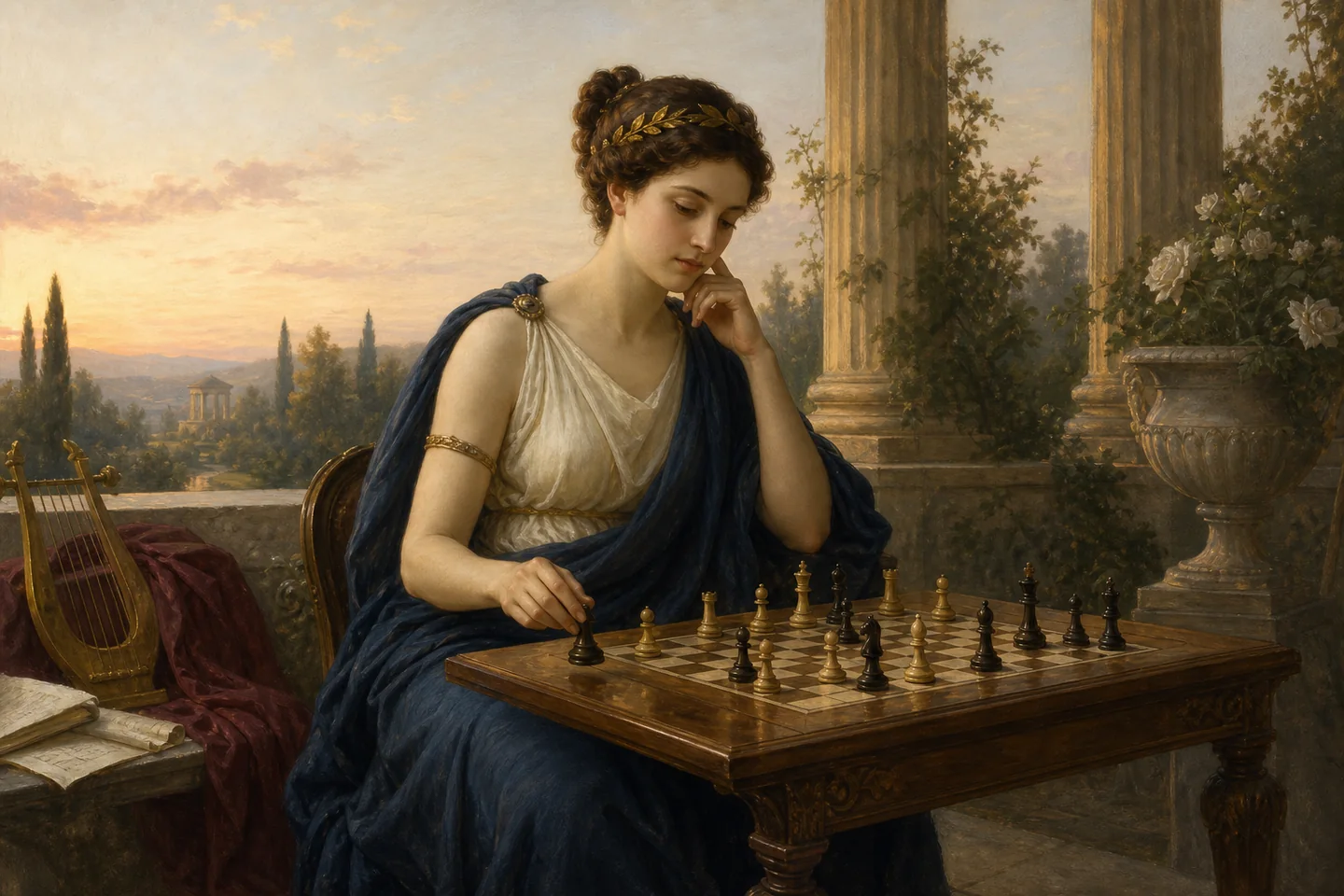
Chess has kings and queens, bishops and knights, but it has no officially recognized goddess inherited from the religions of the ancient world. Caissa does not appear as a deity in the historical Greek or Roman pantheons, and there is no evidence that people in antiquity worshipped her. She is instead a literary creation: a figure shaped by poets and later embraced by chess culture as a graceful personification of the game.
That distinction matters because the familiar phrase “goddess of chess” is symbolic, not a claim about ancient religion. Players also call Caissa the chess muse, invoking the older poetic idea that a muse inspires excellence in an art. In chess writing, her name can suggest inspiration, fortune, beauty, calculation, or the mysterious harmony of a fine game. The language is affectionate and imaginative, much like calling chess the royal game.
This literary identity explains why Caissa feels both classical and modern. Her story borrows the atmosphere of classical mythology, but her connection to chess was made by writers working many centuries after antiquity. The history of Caissa is therefore not the rediscovery of a forgotten goddess. It is the story of how literature gave chess a memorable symbolic figure and how generations of players chose to keep her alive.
The Earlier Literary Roots of the Caissa Tradition
Vida turns the chessboard into a classical stage
The path to Caissa begins before she received that name. During the Renaissance, the Italian poet and churchman Marco Girolamo Vida composed Scacchia Ludus, or The Game of Chess. The Latin poem circulated in the early sixteenth century and appeared in an authorized collection in 1527. Its subject was unusual and ambitious: Vida treated a chess game with the elevated language and mythological scenery of classical epic.
In Vida’s poem, the chessboard becomes a field of stylized conflict watched and inhabited by figures from the classical imagination. A contest between Apollo and Mercury unfolds before the gods, allowing the poet to describe chess as a miniature war governed by wit, order, reversals, and stratagems. The result is playful rather than devotional. Classical mythology provides a literary vocabulary through which a Renaissance writer can celebrate the intellectual drama of the game.
Vida’s work is an important predecessor to the Caissa poem, but the connection should not be simplified into a claim that his central figure was already the Caissa known today. His poem offered an influential model: chess could be narrated through pastoral and mythological invention, and its pieces could carry the dignity of epic actors. That model helped prepare the ground for a later poet to give chess its enduring muse.
William Jones and the Birth of Caissa
How an eighteenth-century poem named the chess muse
The Caissa recognized by modern chess players is chiefly associated with William Jones, the English scholar, linguist, and poet. Jones composed a youthful poem generally dated to 1763 and later included “Caissa, or The Game at Chess” in his 1772 collection Poems, Consisting Chiefly of Translations from the Asiatick Languages. The published title makes the association explicit: Caissa is the figure through whom Jones presents the game in verse.
Jones did not write a historical account of chess, nor did he claim to preserve an authentic ancient myth. He created an elegant poetic fable in a deliberately classical mode. In its broad outline, Mars seeks the attention of the nymph Caissa. When she rejects him, the god turns to an invented game as part of his courtship. Chess enters the story not as an archaeological origin but as a literary gift, surrounded by the conventions of pastoral poetry and Greco-Roman myth.
The poem’s lasting achievement was to provide chess with a name and personality that readers could remember. Caissa stood at the meeting point of beauty and reason, imagination and disciplined play. Although Jones worked in the wake of Vida’s celebrated chess poetry, his Caissa was not simply a renamed character lifted intact from the earlier work. The relationship is one of literary inheritance and reinvention: Vida supplied an important precedent, while Jones fashioned the figure who became the recognized muse of chess.
How Caissa Became the Muse of Chess
A useful symbol for the character of the game
A poem can introduce a figure, but a culture gives that figure endurance. Over time, chess writers and players adopted Caissa as a compact way to speak about the game itself. Her name appeared in chess columns, magazines, clubs, organizations, events, and literary references. Sometimes she represents chess in a formal, almost ceremonial sense. Elsewhere she appears with humor, as when a surprising result is credited to the favor—or displeasure—of Caissa.
The symbol works because chess resists a single description. It is competitive but creative, exacting but imaginative, ancient in inheritance yet continually renewed by new players. A chess position can reward logic, memory, courage, patience, or aesthetic judgment. Caissa gives writers a human figure through whom these qualities can be gathered without pretending that the game belongs to one school, nation, or era.
Calling Caissa a muse also recognizes the artistic side of chess. Players remember combinations whose economy feels beautiful, defensive ideas that appear impossible, and endgames in which every move carries weight. None of this requires belief in a literal supernatural patron. The chess muse is a metaphor for the inspiration players seek when knowledge and imagination meet over the board.
Why We Chose the Name CAISSA Chess
Connecting chess memory with modern play
We chose the name CAISSA Chess because it joins the long cultural memory of chess to the living experience of playing it. The name belongs to no single opening, champion, era, or style. It points instead toward chess as a whole: a game studied in books, contested in clubs, shared online, analyzed move by move, and remembered through the communities that form around it.
That breadth reflects what visitors can already find across CAISSA Chess. Players can enjoy the social atmosphere of CAISSA Classic, connect with the continuing public tradition of FICS, study positions, analyze games, explore opening information, practice endgames, and preserve games in a personal library. These activities are different expressions of the same enduring relationship between play, learning, memory, and discovery.
The name also suits a project that values online chess culture. Digital chess is not only a collection of tools; it includes the rooms, rituals, rivalries, friendships, and interfaces that players remember. Caissa offers an old literary symbol spacious enough to welcome that modern history. Readers who want to learn more about the project’s public purpose can visit the CAISSA Chess About page.
Caissa in the Modern Chess World
Why the symbol still speaks to players
Caissa remains recognizable because chess culture continues to make room for poetry alongside precision. The modern game is documented through databases, broadcasts, engines, notation, and deep analysis, yet players still describe certain moves as inspired. Clubs and publications still reach for historical names that express a shared identity. In that setting, Caissa is not a relic. She is a concise emblem for the imaginative life surrounding the board.
Her history also offers a useful lesson in how traditions form. A Renaissance poet placed chess among classical gods; an eighteenth-century poet created a nymph whose name became inseparable from the game; later players and writers adopted that invention as if welcoming a familiar patron of their art. The tradition is genuine even though the goddess is literary. Its authenticity lies in centuries of chess culture, not in a claim of ancient worship.
So, who is Caissa? She is the symbolic goddess and muse of chess, born from literary invention and sustained by the affection of players. She represents the beauty, struggle, logic, creativity, and fellowship that people continue to find in sixty-four squares. That is the history behind our name—and an invitation to explore CAISSA Chess for yourself.